
Health & Science Editorial
Updated March 2026
After My Skin Cancer Treatment, Even Normal Daylight Felt Like a Threat.
What happened in the two weeks I finally stopped fighting my own skin — and found a sunscreen that protected it without triggering it.
Why post-treatment skin reacts to almost everything — and the one ingredient that finally gave mine room to heal.


By Diana Walsh
Health & Science Editorial
5 Minutes Read

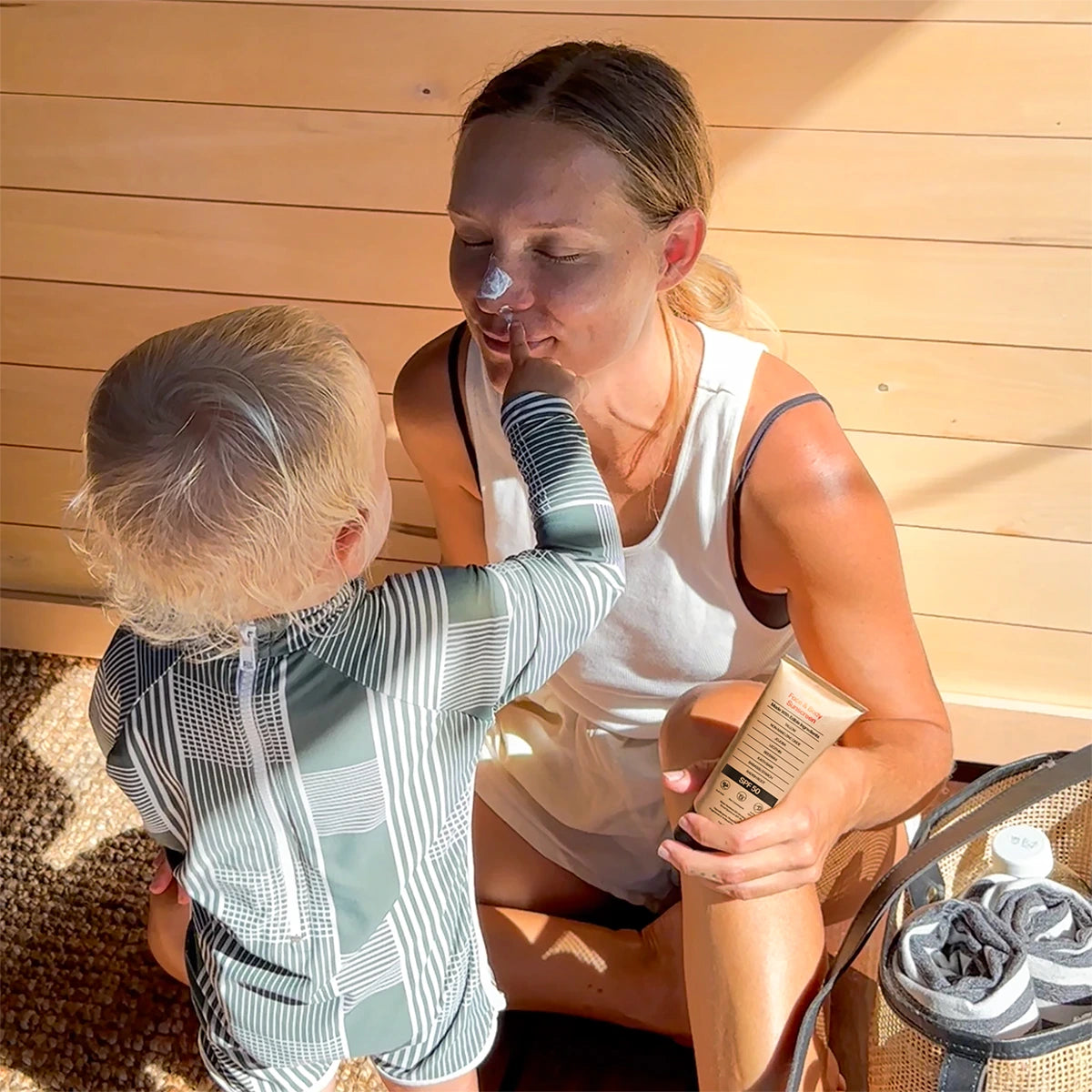
Two weeks after starting Sky & Sol. Not perfect — but no longer fragile.
See Sky & Sol Sunscreen SPF 50
Limited batch — due to grass-fed tallow sourcing constraints
I was diagnosed with basal cell carcinoma fourteen months ago.
The treatment went well. The doctors were pleased.
My skin was not pleased.
After surgery, my face entered a state I can only describe as constantly under attack. Redness that didn't go away. A sensitivity that turned ordinary things — warm water, a light breeze, a few minutes of afternoon sun on the way to my car — into triggers.
I'd spent my whole adult life applying sunscreen religiously. SPF every morning. Never missed a day.
And now, with more reason than ever to protect my skin, I couldn't find a single sunscreen that didn't make things worse.
Every chemical formula stung on contact. Most mineral options left me looking ghostly and felt so heavy my skin couldn't breathe.
I wasn't afraid of the sun. I was afraid of what everything I put on my skin was doing to it.
Why Post-Treatment Skin Reacts To Almost Everything
Here's what nobody explained to me before I started googling at midnight:
After a procedure on the skin — surgical or otherwise — the barrier that normally protects you becomes compromised.
Your skin isn't just healing on the surface. It's in a low-grade inflammatory state underneath.
When you apply a sunscreen that uses chemical UV filters — Avobenzone, Oxybenzone, Homosalate — those molecules don't stay on the surface.
They absorb into the skin to work. And on a barrier that's already compromised, that absorption adds more load to a system that's already overwhelmed.
Studies published in the Journal of the American Medical Association found that chemical UV filters can reach measurable concentrations in the bloodstream within hours of application.
On healthy skin, that's concerning enough.
On post-treatment skin with a compromised barrier, it's like pouring salt into a wound that's still trying to close.
The only UV filter that doesn't absorb — that stays physically on the surface and reflects UV rather than converting it — is zinc oxide.
Non-nano zinc oxide is one of only two active ingredients the FDA classifies as GRASE: Generally Recognized As Safe and Effective.
The problem is that most zinc oxide sunscreens are still unusable for people with reactive skin.
And that's where I was stuck for months.
The Sunscreen Problem Nobody Talks About After Treatment
I went through six mineral sunscreens in three months.
Every one of them left a white cast that made me look ill. And ironically, every one of them also contained silicones or seed-oil derivatives to make the zinc spreadable.
Which meant I was avoiding chemical UV filters but still applying a formula full of ingredients that aggravated reactive skin.
The zinc was right. Everything around it was wrong.
"Her skin stopped feeling constantly under attack. Protection stopped triggering irritation. Healing finally had room to happen."
That description — which a friend sent me from an online community — was the first thing that made me feel understood in months.
Because that's exactly what my skin needed.
Not more active ingredients. Not stronger formulas. Just protection that didn't add to the problem.
What Makes Zinc Oxide Work — And Why The Base Is Everything

See the full ingredient list behind Sky & Sol's SPF 50 formula
I found Sky and Sol through a forum for people navigating sensitive skin after skin procedures.
What caught my attention wasn't the zinc. It was what they used as the base.
Most mineral sunscreens need silicones or synthetic emulsifiers to make zinc spreadable without leaving that thick white paste.
Sky and Sol uses grass-fed tallow instead.
Tallow's fatty acid profile is approximately 50-55% similar to human sebum — the natural oils your skin produces itself.
For context: coconut oil sits at roughly 0-12% match. Most synthetic silicones at 0% — your skin doesn't recognize them.
A 2024 scoping review published in Cureus described tallow as "highly biocompatible" with human skin. When your skin encounters it, it doesn't treat it as a foreign substance.
It absorbs it. Recognizes it. Uses it.
This is why the zinc can be distributed without silicones. The tallow does the work those synthetic emulsifiers normally do — except your skin actually welcomes it.
The result: non-nano zinc oxide sitting on the surface, creating a physical shield from UV.
And a base that supports the barrier rather than further stressing it.
They also added Astaxanthin — an antioxidant that in certain lab tests has shown ~6,000x more potency than Vitamin C — to help neutralize free radical stress from whatever UV gets through.
A defensive line and a cleanup crew working together.
What Happened In Two Weeks

See the Sky & Sol sunscreen that 200,000+ customers apply daily
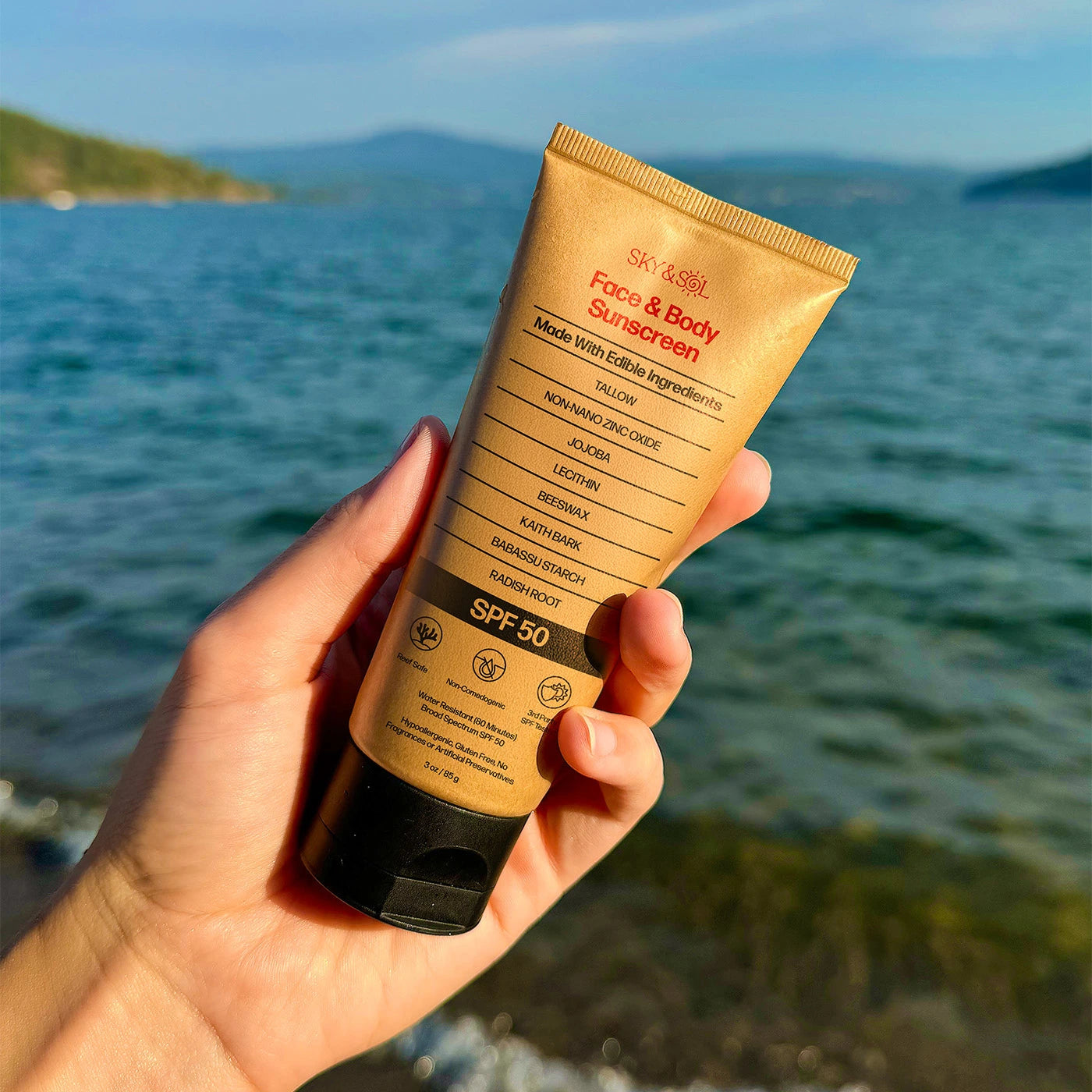
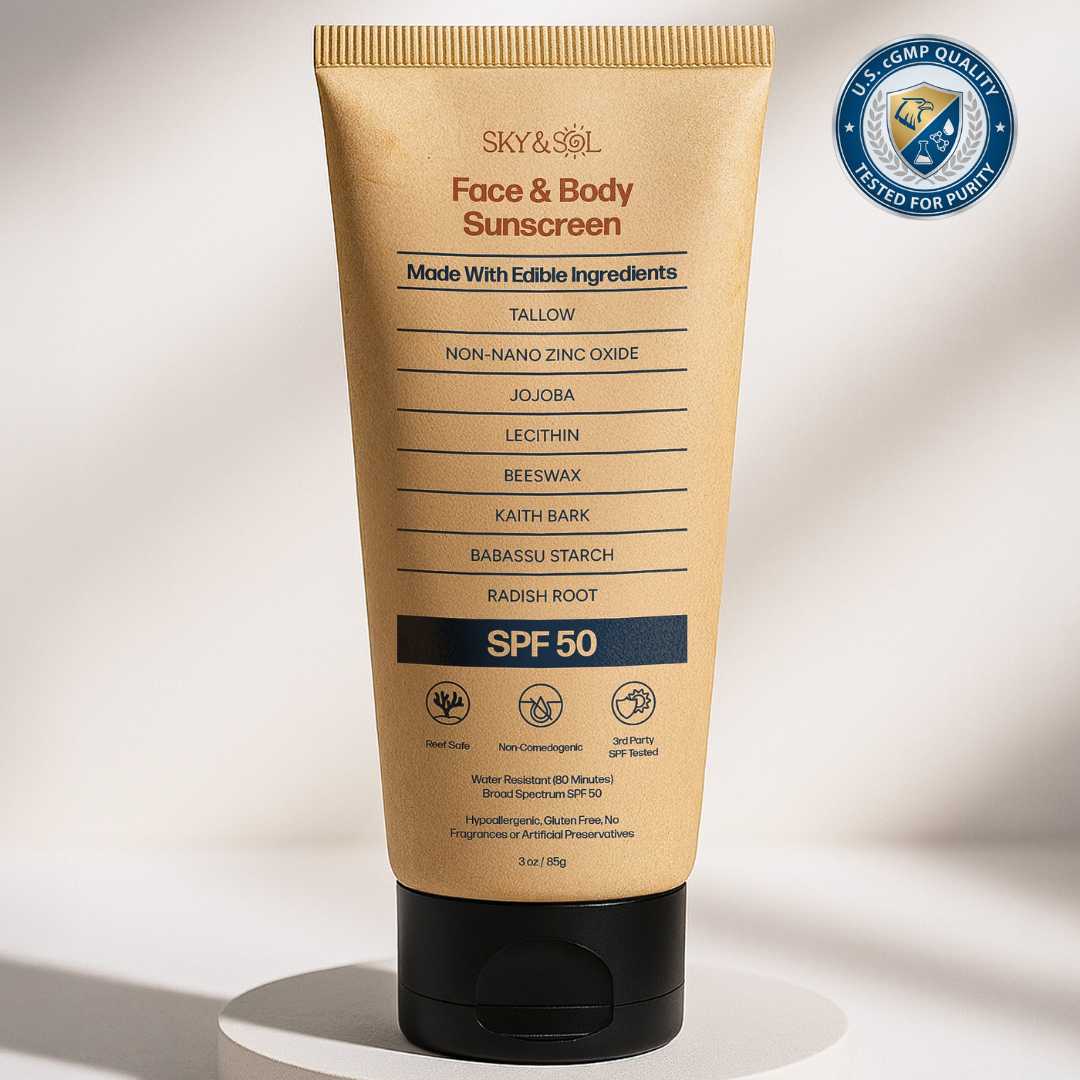
I ordered Sky & Sol Face & Body Sunscreen SPF 50 expecting the usual: heavy, white, and irritating within the hour.
It wasn't.
It went on smooth. No white cast. No sting. No that familiar tightening that told me my skin was about to react.
I held still for a moment, genuinely waiting for it.
It didn't come.
Days 1-3.
My skin wasn't calmer yet. But it wasn't angrier.
For someone who had been in a constant cycle of apply-react-soothe-repeat, neutral was already something.
Days 3-5.
The over-reactivity started pulling back.
I'd been getting a flush of heat and redness every time I stepped outside — even on overcast days.
By day five, I walked to the end of my street and back. No reaction.
I stood there for a second, almost confused.
Day 10.
The redness that had been stacking day after day — layering on itself — started settling.
My skin wasn't perfect. The marks from the procedure were still there.
But it felt like it had stopped fighting.
Week 2.
I went back to my dermatologist for a routine follow-up.
She examined my skin, paused, and said:
"The reactive pattern looks significantly reduced. Are you using something new?"
I told her.
She pulled out a notepad.
She wrote it down.
In eleven years as her patient, I had never seen her do that for a product I'd found myself.
That same week, I took the same morning walk I used to take before my diagnosis.
Same route. Same time.
The difference was that I didn't think about my skin once.
My neighbor — who had watched me come home looking progressively worse over the past months — stopped me at the corner and said: 'You seem like yourself again.'
I didn't explain what had changed. I just smiled.
The Brand Behind The Formula

Check if Sky & Sol SPF 50 is currently in stock
Sky and Sol was built on one rule:
If it's not safe enough to trust around your body, it has no business going on your skin.
Their founder, Max Medroso, built the brand after his own health transformation — and asked the question most sunscreen brands never ask: why do we hold food to a higher standard than skincare?
The answer became a strict internal standard: every ingredient must be either food-derived or proven biocompatible with human skin — no synthetic shortcuts.

The formula:
100% Grass-Fed/Grass-Finished Tallow
→ Bioidentical lipids — 50-55% match with human sebum
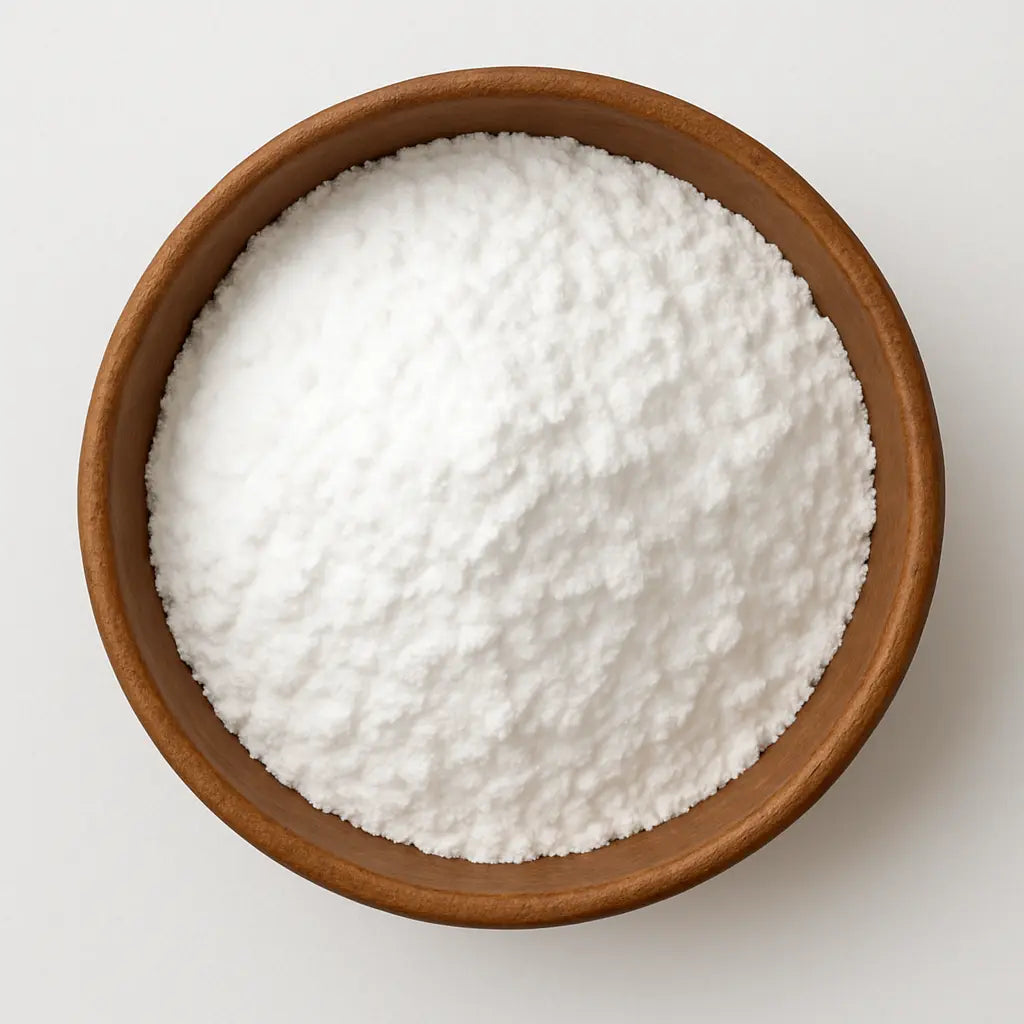
Non-Nano Zinc Oxide
→ Physical UV barrier. FDA GRASE. Stays on the surface.
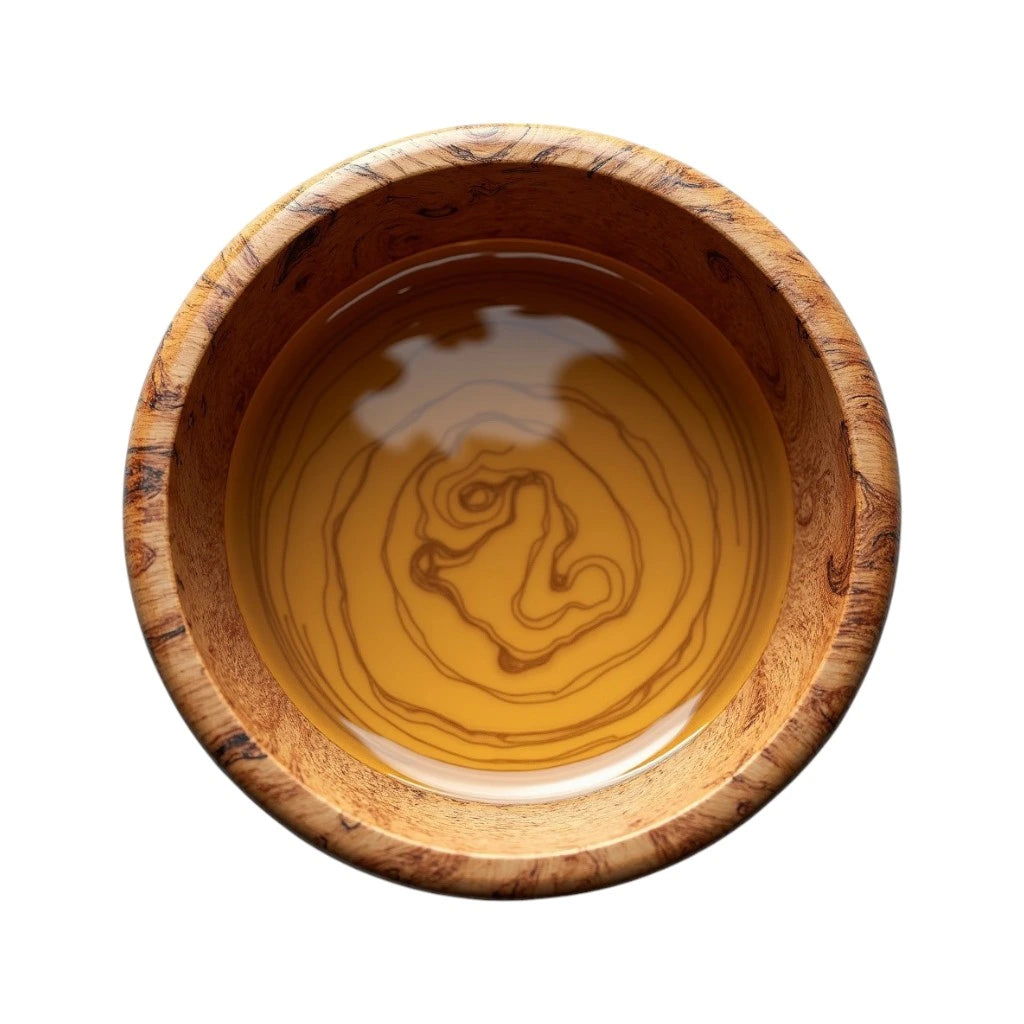
Cold-Pressed Jojoba
→ Mimics skin's own sebum. Coats zinc to reduce
white cast.
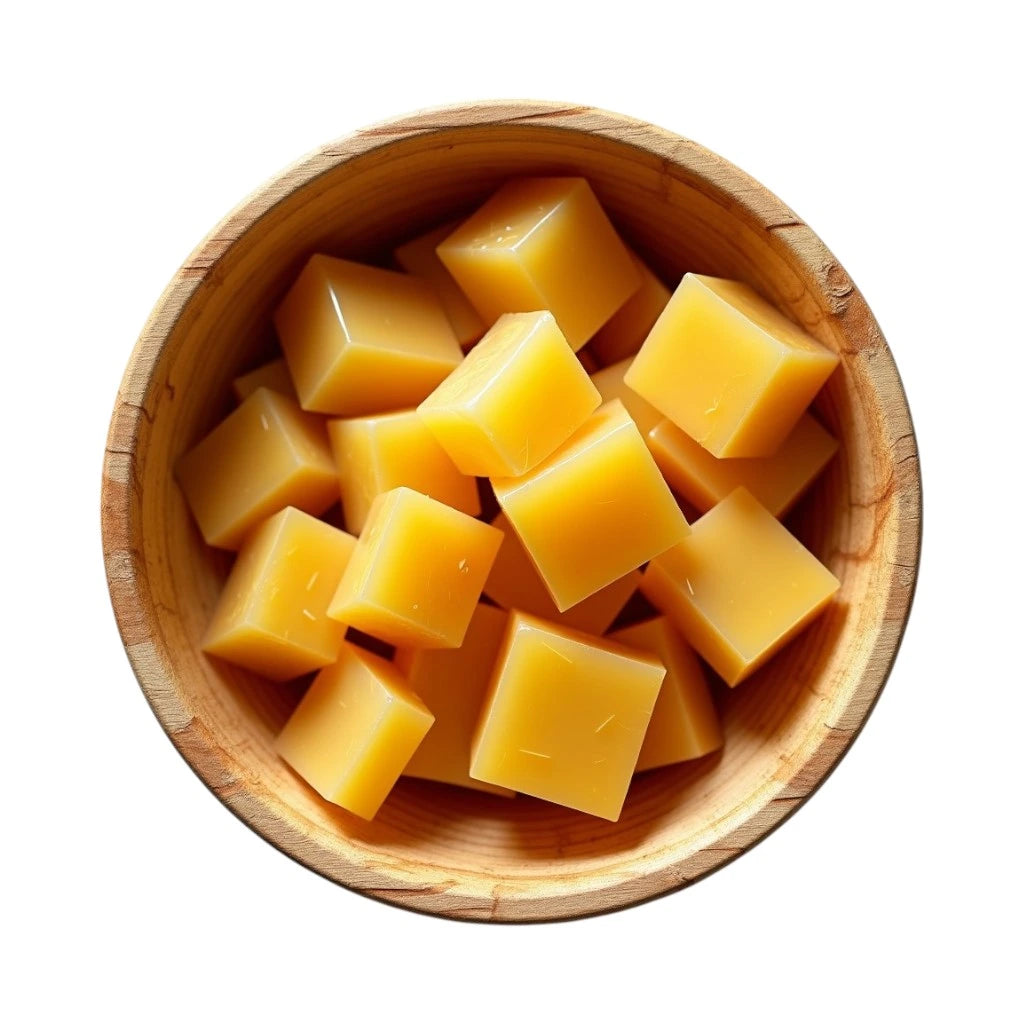
Beeswax
→ Water resistance up to 80 minutes. Breathable barrier.
Astaxanthin
→ Antioxidant support against free radical stress from UV.
Radish Root Ferment Filtrate
→ Natural antimicrobial preservation.
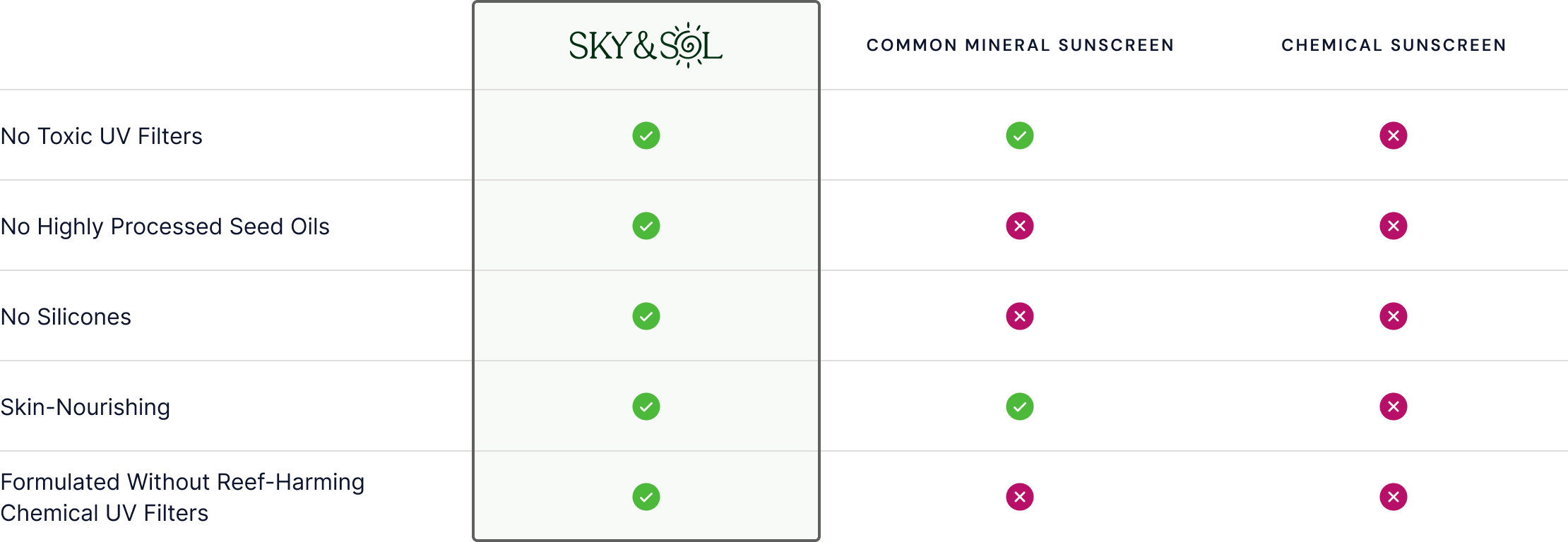
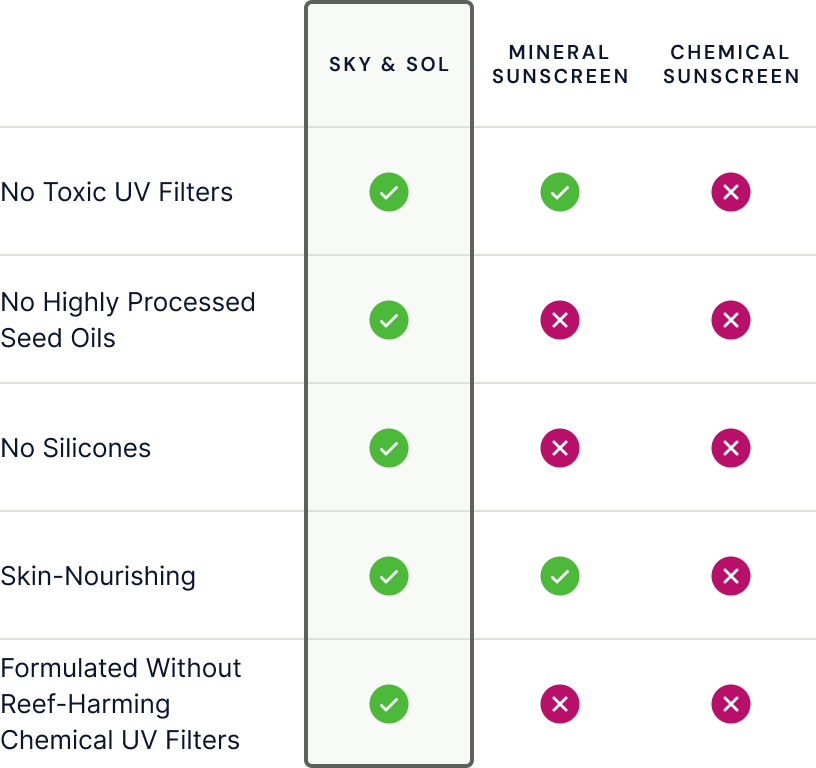
Formulated without chemical UV filters, highly processed seed oils, silicones, synthetic fragrance, or intentionally added parabens, phthalates, or PFAS. Formulated without reef-harming UV filters banned in Hawaii.
The Brand Behind The Formula
No Chemical UV Filters
No Highly Processed Seed Oils
Bioidentical Tallow Base
Anti-White Cast Tech™
No Silicones
FDA GRASE Active (Zinc Oxide)
180-Day Guarantee
✅
✅
✅
✅
✅
✅
✅
Common Mineral Sunscreens
✅
❌
❌
❌
❌
✅
❌
Chemical Sunscreens
❌
❌
❌
❌
❌
❌
❌
Try Sky & Sol Sunscreen Risk-Free

Lu
Verified Customer
"BEST SUNSCREEN EVER"
"I swear I look younger after two weeks of using this cream! I feel refreshed, non-greasy, but deeply hydrated. I am kind"Finally a great sunscreen for older women. It doesn't leave the skin greasy and actually feels like skincare."a obsessed!"

Michelle S.
Verified Customer
"WILL BUY AGAIN AND AGAIN"
"It is nice to finally find a sunscreen that is healthy for your skin. It blends in quickly and does not leave any white residue. Can easily be used under foundation."

Susan
Verified Customer
"GREAT PROTECTION"
"I love this sunscreen! It feels so good on my skin and leaves no white residue. I have dry sensitive skin and experience no irritation or dryness. It actually feels soothing while protecting me from harmful rays."
4.53/5 stars · 3,700+ verified reviews · 200,000+ customers
Why It Keeps Selling Out — And How To Get Yours

Sky and Sol uses 100% Grass-Fed/Grass-Finished Tallow sourced from small specialized farms. Supply is finite. They don't compromise sourcing to scale production.
Demand has increased significantly in recent months. If it's currently in stock, that won't last.
Step 2
CHOOSE YOUR QUANTITY
SPF 50 for maximum protection and daily face use.
SPF 30 for everyday use.
Buy One, Get One 10% OFF + Free Shipping.
Buy 3, Get Two at 15% OFF + Free Shipping.
Step 3
ZERO RISK — 180-Day Guarantee
Use the entire tube. If you don't feel your skin is healthier and better protected — send it back. Full refund. No questions asked. Even if the tube is empty.
Try Sky & Sol Risk-Free
4.53/5
3,700+ reviews
180-Day Money Back Guarantee
Free Shipping
HSA/FSA Eligible
Frequently Asked Questions
Sky & Sol uses non-nano zinc oxide — a physical barrier that stays on the skin's surface rather than absorbing into it. The tallow base is bioidentical to human sebum, which means the skin recognizes and tolerates it well. The formula is made without silicones, synthetic fragrance, or chemical UV filters. For specific medical concerns, always consult your healthcare provider.
Sky & Sol coats non-nano zinc oxide with cold-pressed jojoba ester — a technique that prevents zinc particles from clumping, which is what causes the chalky finish in most mineral sunscreens. Over 92% of surveyed customers report less white cast than other mineral sunscreens they've used.
Sky & Sol is water resistant up to 80 minutes per the FDA OTC Sunscreen Monograph. Reapplication is recommended after water exposure or extended outdoor activity.
ACOG (American College of Obstetricians and Gynecologists) and AAD (American Academy of Dermatology) both recommend mineral sunscreens — particularly zinc oxide — for use during pregnancy. For specific guidance, consult your healthcare provider.
Yes. Sky & Sol is kid-friendly for ages 6 months and up.
One Last Thing

I still apply sunscreen every morning.
Every single day. Same as before the diagnosis.
But now I don't flinch when I do it.
The marks are still there. Some redness. The evidence of what my skin went through.
But it doesn't feel like a field of landmines anymore.
Post-treatment skin doesn't need a miracle product.
It needs protection that understands it's already been through enough.
For me, that was Sky & Sol Face & Body Sunscreen SPF 50 — the first formula that protected my skin without asking it to handle anything more.
Try Sky & Sol Risk-Free
4.53/5
3,700+ reviews
180-Day Money Back Guarantee
Free Shipping
HSA/FSA Eligible
Sources
1. Matta, M.K., et al. (2019). "Effect of Sunscreen Application Under Maximal Use Conditions on Plasma Concentration of Sunscreen Active Ingredients." JAMA, 321(21).
2. Dyer, J.A., et al. (2024). "Tallow and skin biocompatibility: a scoping review." Cureus, June 2024.
3. FDA (2019). "Sunscreen Drug Products for Over-the-Counter Human Use." Federal Register, 84(38).
4. ACOG Committee Opinion (2020). "Cosmetics and Skin Care Products During Pregnancy." American College of Obstetricians and Gynecologists.
5. Lim, H.W., et al. (2017). "Current challenges in photoprotection." Journal of the American Academy of Dermatology, 76(3).
This content is for informational and educational purposes. It is not intended to diagnose, treat, or cure any condition. Consult your healthcare provider for medical advice. Individual results may vary.